


Teaching Practice
- Gaven Qhristian Contreras
- Dec 21, 2023
- 4 min read

PROCEDURE
A. PRELIMINARIES
Teacher shall greet the students and introduce self. After the introduction, the teacher intern will take the attendance then proceed to the motivation.
B. MOTIVATION
The intern will ask the students the question, “Have you travelled before?” and illicit responses. Then proceed to show pictures of famous landmarks from the Philippines. While showing popular landmarks, the intern will ask the questions such as, “Have you seen a volcano before?” or “Have you been to a beach?” and try to get responses following the sentence pattern of present perfect tenses.
C. LESSON PROPER
(Throughout the lesson, Bahasa translations are included to reinforce teaching)
Proceed to the topic recall of Present Perfect Tenses by using the question “Have you travelled before” as an example. Then introduce present perfect tense discussion and types.
Present Perfect Tenses
Are used to talk about actions or events that started in the past and continue up to the present or recently happened. It follows the pattern have/has + past participle which commonly uses the words: never, ever, since, for, just.
Has and have are mandatory when it comes to present perfect tenses. They are auxiliary verbs, used with another verb to form tenses, negatives, and questions. Have is used with pronouns I, you, we and they, and plural nouns. While Has is used with the pronouns he, she, and it, and singular nouns.
Present perfect tenses are used to indicate the following:
1. Finished actions
2. Recent completed actions
3. Unfinished actions
4. Life experiences
5. Accomplishments
6. Changes over time
Intern will give an example for each type and then ask the students to give examples.
The teacher intern welcomes the students, immersing them in the captivating theme of the Philippines for the day's lesson. To foster sustained engagement and attentiveness, an interactive rule is introduced. As part of this thematic activity, every time the intern performs three claps, students are encouraged to respond with a spirited "Mabuhay," a Tagalog expression meaning "Welcome," while simultaneously raising both of their hands. This lively interaction not only adds an enjoyable dimension to the lesson but also aligns seamlessly with the cultural essence being explored.
Throughout the virtual tour of the Philippines’ geography, people, food, symbols, and literature, the teacher intern will ask questions in present perfect tense pattern such as “Have you eaten a mango before?”, “Have you seen an eagle?” etc.
Introduction of local literature is also introduced to the students to learn about the culture of the Philippines. Teacher intern will read some parts of the story Biag ni Lam-ang and will ask a student or the entire class to read some portions of the story.
D. APPLICATION
The students shall play an interactive quiz bee game about the presented literature, Biag ni Lam-ang, where they are situated at the back of the classroom and when a question is presented, they must line up in either Option A or Option B which contains the answer of the question.
E. EVALUATION
The students are then task to answer a short quiz to test their knowledge on present perfect tense.
F. ASSIGNMENT
Now, they are task to compose a narrative essay talking about the student’s real or imaginary vacation experience using the present perfect tense by being guided by a rubric
Time management and Organization of Activities
Activities are divided according to the components of a lesson plan and the objectives. For the preliminaries, less than 5 minutes is allocated for a self-introduction, checking of attendance, and setting up classroom rules. 30-45 minutes is allocated for the lesson plan, where motivational activity if 5-10 minutes. The application where the students played a game is to last 15 minutes and for the evaluation which is a quiz is 15 minutes. The remaining time is allocated for giving instructions of the assignment and saying goodbye to the students.
Arrangement of activities is done according to the Bloom’s Taxonomy.
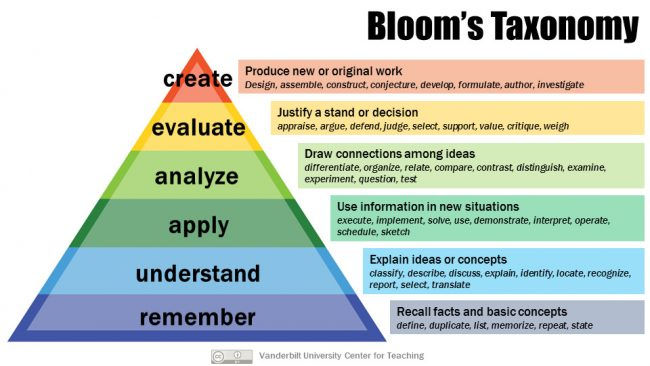
Starting from the bottom, students will have to recall facts and basic concepts like what they know about the Philippines and about the topic which falls under Remembering.
During the lesson, students are to respond to my question using present perfect tense which falls under Apply.
As for the application where they played the game, it uses Remembering since they remember facts from the story Biag ni Lam-ang.
As for the Evaluation, it composes questions targeting both lower and higher thinking skills of students that fall under the taxonomy.
Then, they are given the task to compose an essay which falls under creating, the highest order of thinking in the Bloom’s Taxonomy.
Classroom Management

Being a new teacher, it is expected that students will be wary of you and respect isn't earned yet since authority hasn't been established that is why there will be times students will be noisy and will not listen to you. To ensure that students will listen to my discussion and our engaged, I employed a strategy that checks their attentiveness. Throughout the discussion, when my students hear me clap three times, they have to say "Mabuhay" which is a Filipino word that means "Welcome" and raise their hands. This way, they are energized and expected to listen. As for my application activity where they played a game, the students are expected to get rowdy and hyper, if the strategy mentioned do not work, then I will tell the students that we will stop the game, which happened to one of class, then they stopped immediately since they wanted to play.
Problem-solving while teaching and staying in the designated school
The main problem I had during my stay was the language barrier. There are students who cannot communicate in English nor understand since English is their third language as EFL learners. Still they were not afraid to come and interact and if they wanted to tell something, they use google translate and we also use google translate.


Comments